Your Brain Won't Stop.Your Body Can.
A 7-day protocol using sensory grounding techniques to interrupt the physical stress loop behind overthinking — no meditation app, no journaling, no "just relax."
Takes 10 minutes a day. Built on techniques studied in trauma and anxiety research.
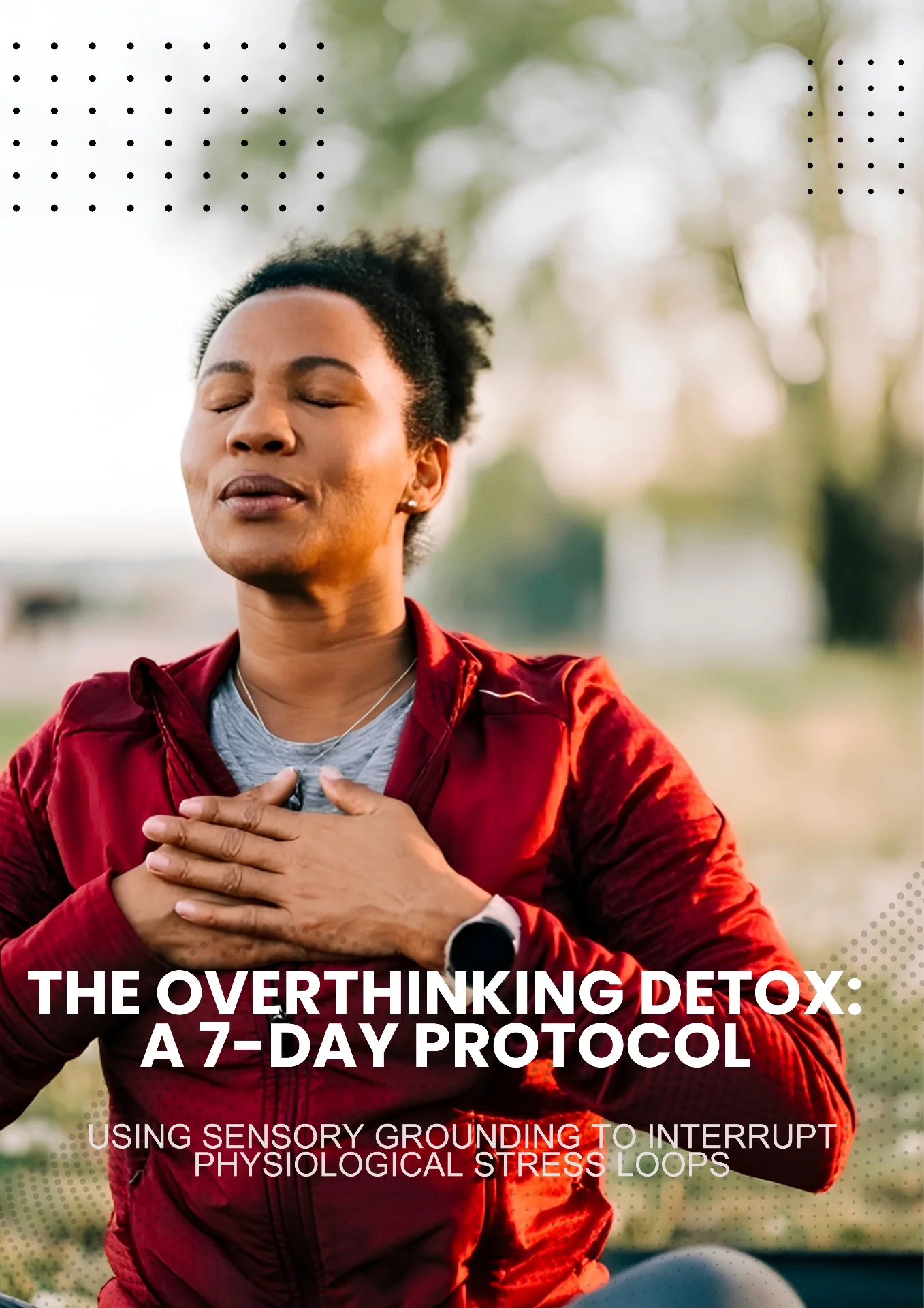
7 days · 7 practices
Short daily reading + one physical thing to do
The 2am problem
You're not overthinking because you're weak-willed.
It's 2am and you're replaying a nine-second moment from a conversation that ended eleven hours ago. The exact phrasing. The pause afterwards. What it probably meant. You have been through this loop maybe forty times and it has produced nothing except a slightly sharper version of the same dread.
And it's not only in your head. There's a tightness across your chest, a jaw you didn't realise you were clenching, that low static hum in your stomach that shows up before you've even remembered what you're worried about.
The maddening part is that you're smart. You can see the loop while you're inside it. You know the catastrophe isn't likely. You can argue against every thought and lose anyway, because being right has never once made it stop.
So you've tried things. The meditation app with the nine-day streak that ended in March. The journal you filled for a week. The friend who told you to just relax, which landed about as well as you'd expect. None of it was wrong, exactly. It just didn't reach the part of you that was actually alarmed.
Why this works
Overthinking isn't a thinking problem. It's a nervous system problem.
The alarm switches on
Something registers as a threat — a tone of voice, an unread message, a deadline. Your body shifts into a stress response: faster heart, tight chest, tense jaw. Useful, in the short term.
The alarm gets stuck
The moment passes but the physical state doesn't fully clear. Your mind reads that leftover activation as unfinished business, so it keeps searching for the thing to resolve. That searching is rumination.
Thinking can't turn it off
You're trying to solve a physiological state with a logical argument. That's why insight doesn't help. The loop isn't asking to be understood — it's asking for evidence that you're safe now.
So we use a different door: your senses.
Sensory grounding means deliberately feeding your nervous system present-moment information through touch, sound, sight, breath and movement. Cold water on your wrists. Pressure through your feet. The specific texture of the thing in your pocket. It's ordinary, almost embarrassingly simple, and it works on a channel that arguing with yourself can't reach.
Grounding skills like these are widely taught by clinicians and used in everyday stress-management practice. This isn't a cure and it isn't magic — think of it as a practical, repeatable way to bring the physical intensity down enough that your thinking has somewhere calmer to land.
What's inside
The 7-Day Protocol
One short reading each day (5–7 minutes) plus one physical practice, in a PDF workbook you can read on your phone or print out.
- Day 1
Name it to tame it
A 2-minute grounding reset for the moment a spiral starts — plus how to spot your own early warning signs.
- Day 2
Touch is the fastest door
Temperature, pressure and texture drills you can run under a desk without anyone noticing.
- Day 3
Sound as an anchor
Using ambient sound and your own humming to pull attention out of the replay loop and into the room.
- Day 4
Breath, but with your body
Longer exhales paired with a physical cue, so the breathing actually lands instead of feeling like homework.
- Day 5
Visual anchoring
A simple 3-object scan that stops the 2am ceiling stare and gives your eyes somewhere to rest.
- Day 6
Stacking senses under stress
Combining two or three anchors at once for the harder moments: hard conversations, inboxes, waiting rooms.
- Day 7
Your personal 90-second reset
Build one short sequence from what worked for you, written on a card you'll actually keep using.
Not Just Another Listicle
Free lists of 30 grounding techniques are everywhere online. They can help, but they don't show you how to build a reliable habit. This is a structured day-by-day progression, so each practice prepares you for the next, and by Day 7 you have one personal, repeatable reset you can use anywhere — delivered as a PDF workbook you can read or print, not just another scrollable list.
This is for you if...
- Your brain won't switch off at night, even when you're exhausted.
- You've already tried logic, willpower and "just stop worrying."
- You want something physical you can do in the moment, not later in a journal.
- Ten minutes a day is realistic for you. Forty-five is not.
This isn't for you if...
- You're looking for a replacement for therapy or medical care.
- You want a 300-page deep-dive into the research literature.
- You need clinical treatment for a diagnosed anxiety disorder — please work with a licensed professional; this can sit alongside that, not instead of it.
Early readers
What it's actually like to use
"I used the touch grounding thing during a performance review, holding the cold arm of the chair, and I got through it without my voice shaking. That has never happened."
"I usually replay conversations until about 2am. Day 5's three-object scan sounded too simple to matter. I've fallen asleep before midnight four nights this week."
"I've bounced off three meditation apps because sitting still made the thinking louder. Doing something physical with my hands was the part that finally stuck. I also liked that it doesn't pretend to be therapy — it made me feel safer about reaching out to a professional when I needed one."
Fair questions
Before you buy anything
You don't have to think your way out of this.
Using sensory grounding to interrupt physiological stress loops.
Instant download • Works on any device • 7 days to a reset you can use anywhere